K-Challenge Lab and Delavergne Shipyard join forces to accelerate the emergence of a concrete, sovereign hydrogen solution for the maritime sector
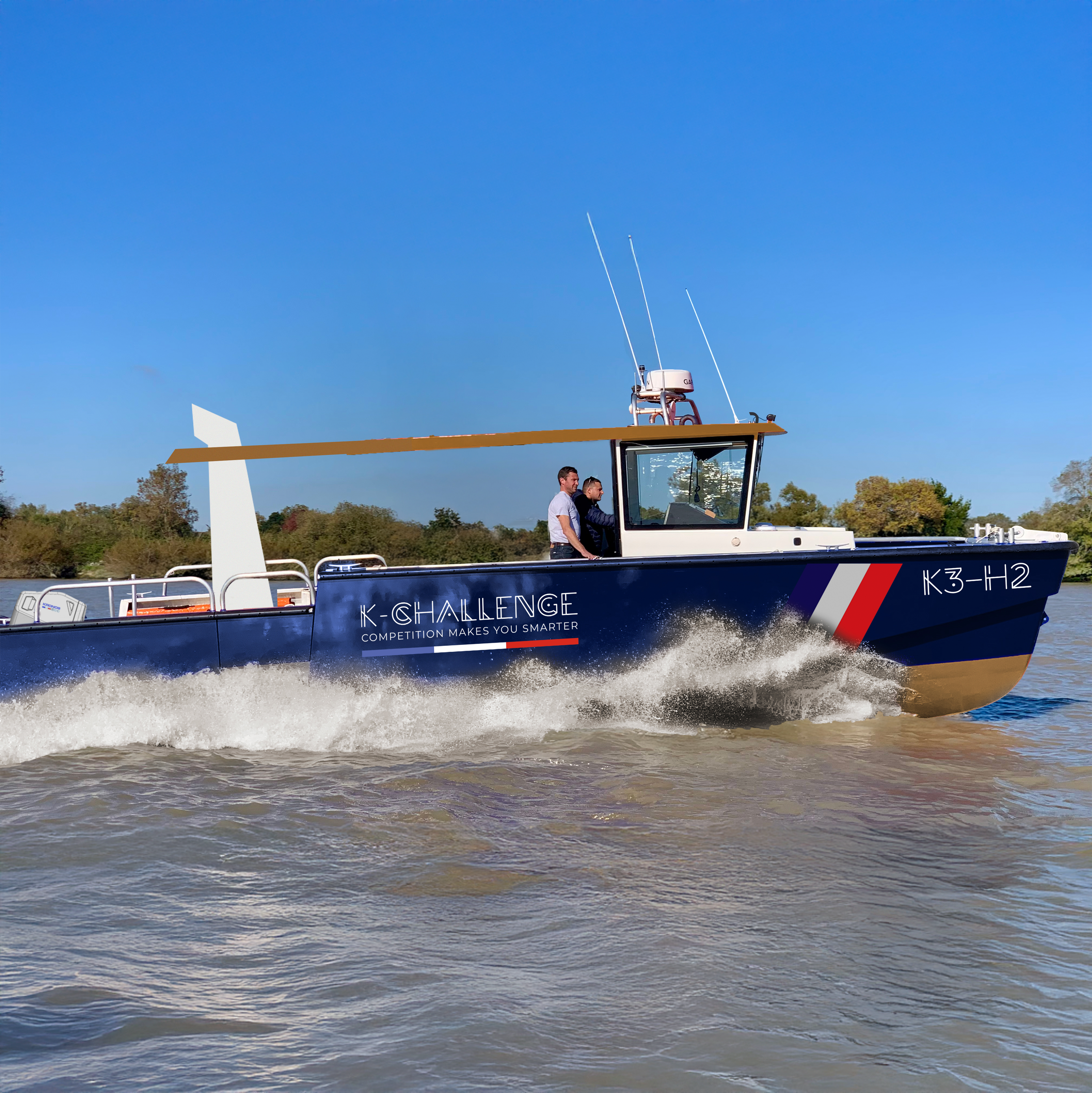
K-Challenge Lab has partnered with Delavergne Shipyard to develop and deploy a hydrogen-powered professional vessel, marking a significant step towards the decarbonisation of maritime operations. The partnership will deliver a 12-metre aluminium workboat equipped with a hydrogen propulsion system, with sea trials scheduled for summer 2026 in Lorient.
The project targets immediate emissions reduction in the professional maritime sector, offering a zero-emission propulsion solution designed for real-world operational use.
Commercial deployment is planned to begin in 2026, with turnkey solutions aimed at workboats, port services and coastal operations.
Delivering an operational hydrogen solution for maritime professionals
Supported by the Brittany Region, K-Challenge Lab and its partners—Hopium, Argo-AnLeg and Kinell (Fetis Group)—are developing a fully integrated, marine-certified hydrogen propulsion system tailored to the needs of professional vessels.
Rather than focusing solely on propulsion, the project addresses the entire operational ecosystem. The solution integrates:
• on-board power generation using a hydrogen fuel cell,
• secure hydrogen storage and management systems,
• a complete energy architecture and safety framework,
• and a dedicated mobile hydrogen refuelling station designed for port environments.
This end-to-end approach aims to remove the technical and operational barriers that have so far limited hydrogen adoption in the professional maritime sector.
“Decarbonising maritime transport requires more than an alternative engine. It means designing a complete, operational system that works within real regulatory and operational constraints,” said Étienne Rochon du Verdier, Hydrogen Lead at K-Challenge Lab. “Our focus is on delivering a hydrogen solution that is safe, credible and deployable today—not in ten years.”
A full-scale demonstrator built on a proven workboat platform
Delavergne Shipyard, which brings more than 30 years of experience in building professional aluminium vessels up to 45 metres, will construct the demonstration vessel based on its Exocet 10 platform.
The hull and deck will remain identical to the production model, ensuring that performance, seaworthiness and operational characteristics are fully representative of vessels currently in service. Only internal adaptations required for hydrogen system integration will be made.
Designed by naval architecture firm H&T, the sub-12-metre vessel targets a strategically important segment for port operations, coastal services and maritime support activities.
“Integrating hydrogen propulsion on a vessel of this size is both a technical challenge and a major opportunity,” said Jean-Marie Coudé, CEO of Delavergne Shipyard. “This project allows us to prepare today for solutions that will soon become standard in professional shipbuilding.”
Accelerating the transition from pilot to market
For K-Challenge Lab, the partnership provides a direct pathway from demonstration to commercial deployment, leveraging an existing,
certified professional vessel platform.
“Our first unit will be used to obtain the required certifications and demonstrate real operational performance,”said Stephan Kandler, CEO
of K-Challenge Lab.“Working with an experienced shipyard on a proven workboat enables us to move quickly from pilot vessel to market ready solution.”
For Delavergne Shipyard, the collaboration positions the company at the forefront of hydrogen integration for aluminium workboats, at a time when environmental regulations and customer expectations are rapidly evolving.
“The maritime energy transition will be driven by concrete, collaborative projects that deliver real operational results,” concluded the project partners.
Key milestones
January – early July 2026: Hull construction and system integration in Nantes
From July 2026: Sea trials and operational testing in Lorient
2026 : Commercial deployment
Technical overview
Length: 10.80 m (11.90 m fully equipped)
Beam: 3.82 m
Weight: 5.5 t (conventional version) / 7 t (hydrogen version)
Top speed: 35 knots
Cruising speed: 16–25 knots
Platform: Exocet 10
Construction: Aluminium
Shipyard: Delavergne
Naval architect: H&T
Manufacturing site: Bouguenais, near Nantes
Fuel cell: Hopium (~200 kW)
Battery system: Kinell (Fetis Group)
Mobile hydrogen refuelling station: Argo-AnLeg