Innovate, collaborate, decarbonize maritime transport here and now. Towards a hydrogen solution made in Brittany.
In Lorient, during BrittanHY Day, the annual must-attend event for the hydrogen sector in Brittany, K-Challenge presented, in the presence of its partners—Hopium, Fétis Group, Argo Anleg, and the Brittany Region—its project to design and build a testing platform for hydrogen gas ships and its prototype refueling station, with testing scheduled to begin in the summer of 2026.
Impactful Sport-Tech, K-Challenge, a company specializing in nautical competition and maritime innovation, is committed to zero-carbon mobility. It is using its participation in events such as the America's Cup and the Lab's expertise to accelerate R&D and the development of high-tech hardware and software solutions (high-speed foil drones, naval operating systems, race performance analysis). However, it is particularly in the field of hydrogen propulsion that K-Challenge Lab is ahead of the market.
Cliquez ICI pour visualiser l'image
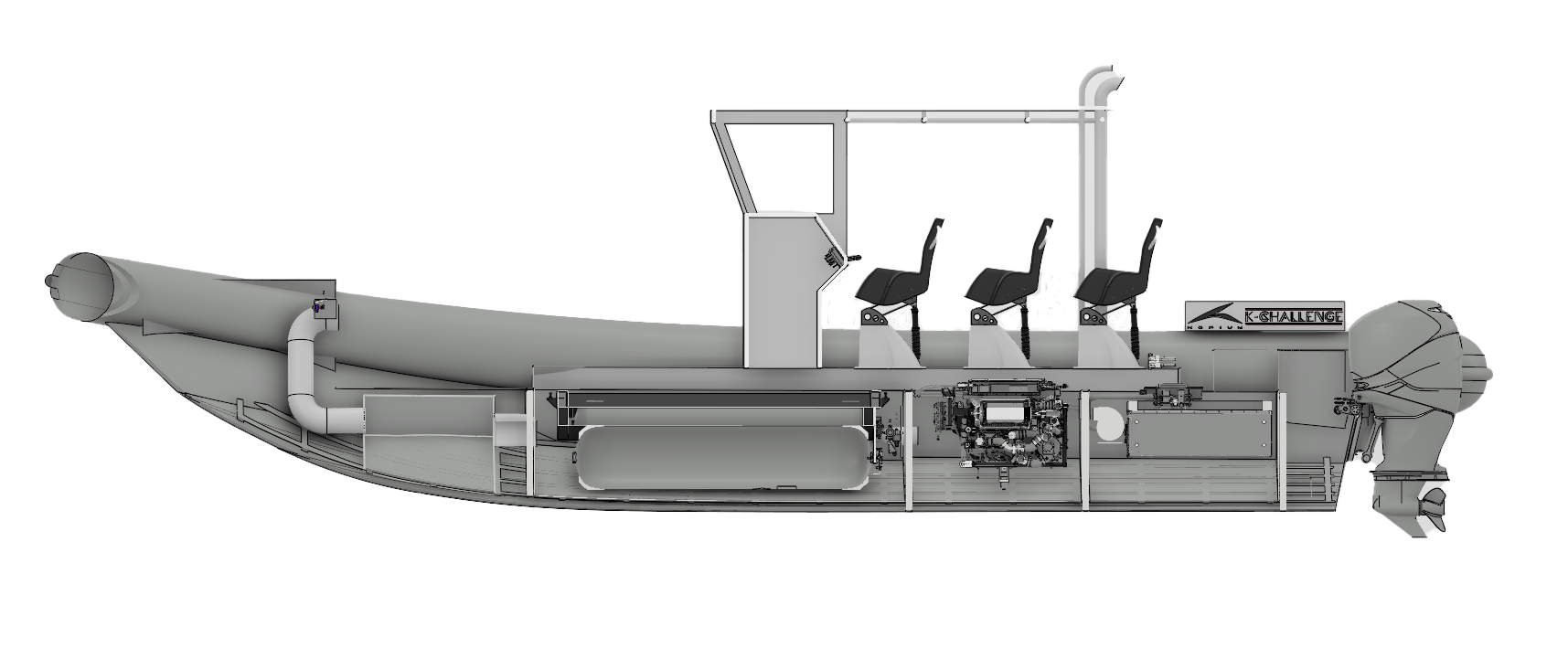
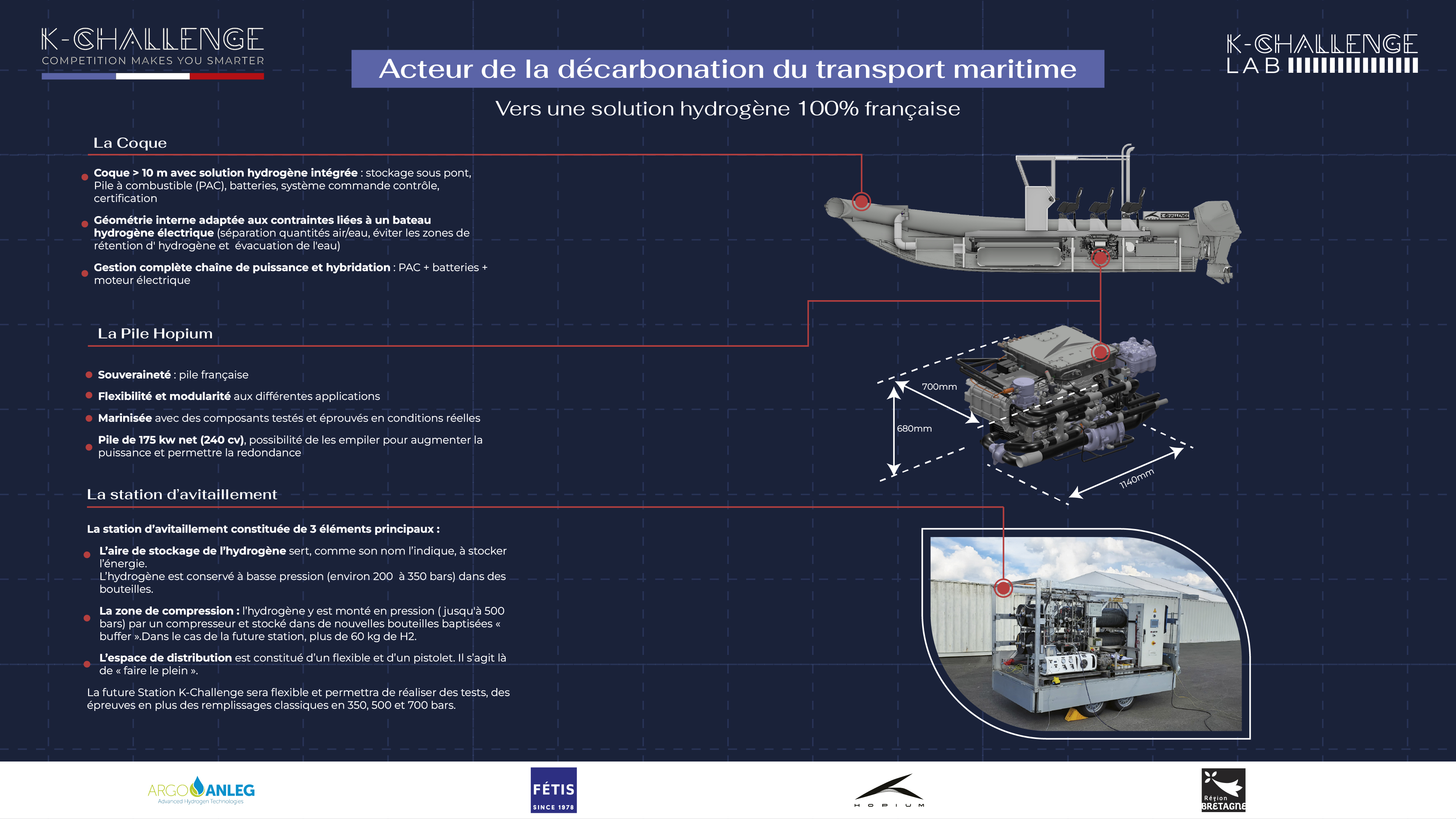
The 37th America's Cup, K-Challenge Lab is launching the design of a vessel over 10 meters long, which will serve as a platform for testing a complete, compact, and marine-ready hydrogen power train. This will enable the testing of all of its components, including hydrogen distribution via a mobile station. This major first will also enable work to be carried out on hydrogen refueling protocols in port areas.
At the end of these experiments, which will begin in the summer of 2026, all the data collected will be analyzed and then used as a solid basis for defining the industrial solution.
Details provided by Etienne Rochon du Verdier, Head of Hydrogen at K-Challenge Lab:
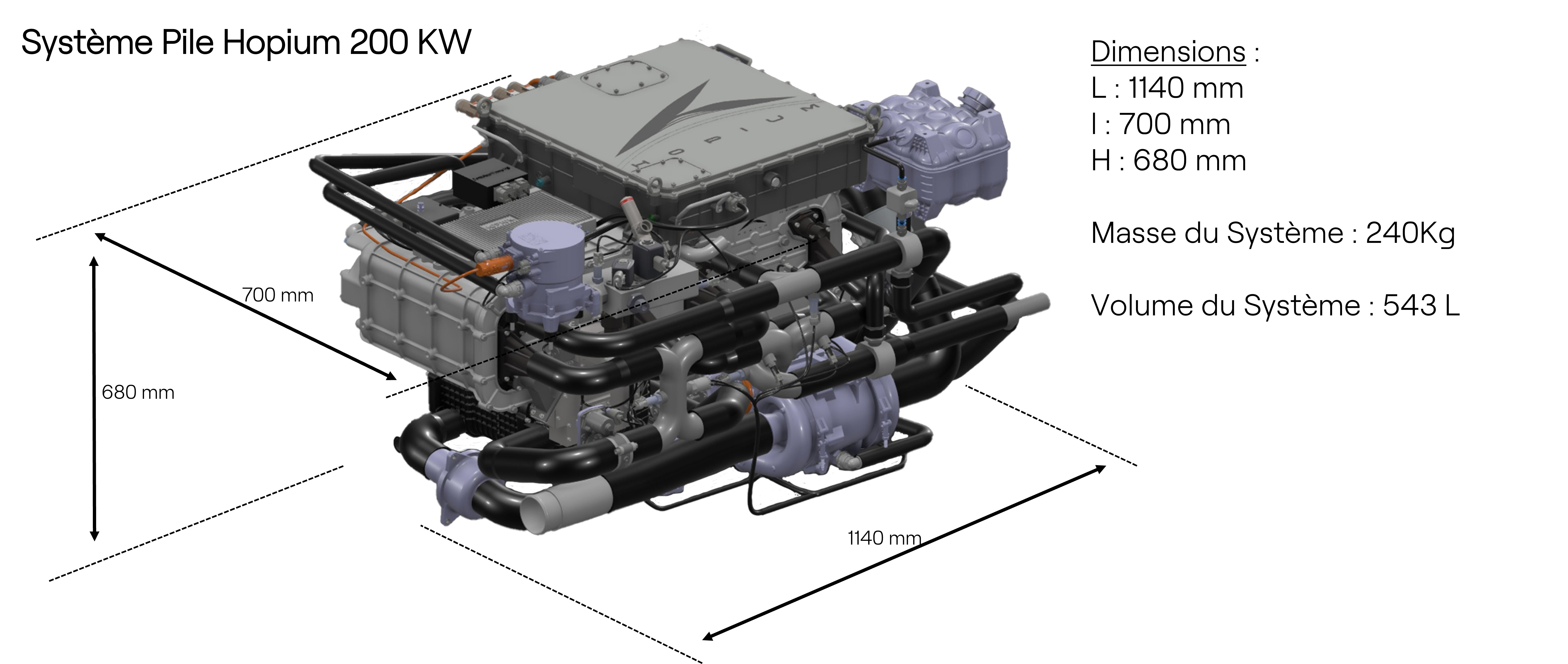
"After acquiring knowledge from our hydrogen-powered catamaran with foils, we are embarking on a collective venture with private partners such as Hopium, Fétis Group, Argo Anleg and with the support of the Brittany Region and Lorient Agglomération. Together, we will collaborate on the design and launch of a 10.80-meter vessel with an electric motor equivalent to 600 horsepower and equipped with a 200 kW marine fuel cell system.
We see no added value in tackling the construction of the hull, which we will leave to French shipyards. However, we will focus our efforts on the interior geometry to ensure that it is adapted to the constraints associated with the use of a hydrogen-powered boat and also to the management of the power chain.
The fuel cell used will be the one designed by the French company Hopium, based near Lyon. It is flexible, modular, and will be marine-grade with components tested in real-world conditions.
The storage of hydrogen gas in a semi-confined space, its distribution, and its bunkering will be the responsibility of the Fétis Group, based in Nantes.
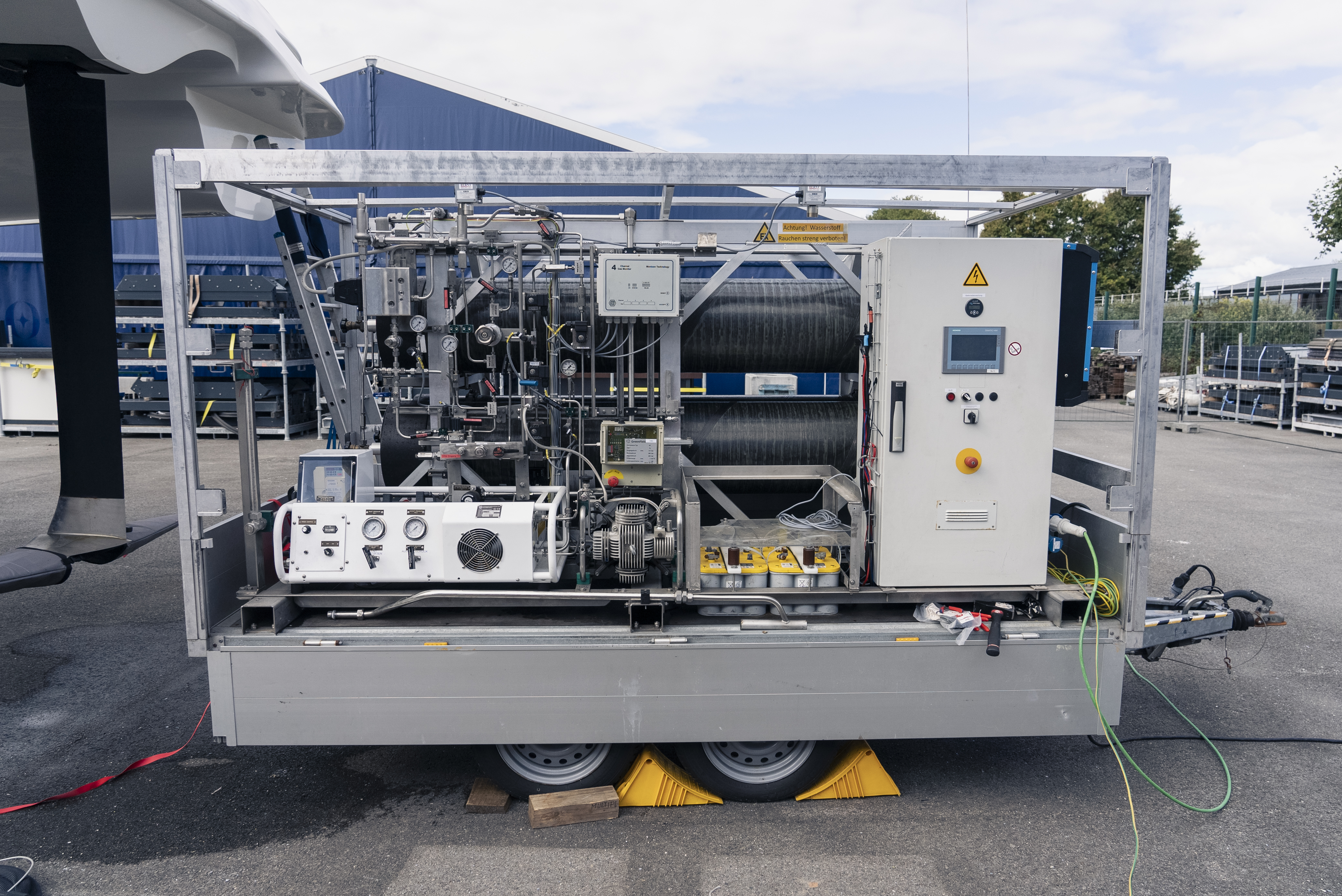
As for the hydrogen gas refueling station, we are acquiring it from our partner Argo Anleg in order to be at the heart of a region that is very committed to hydrogen.
We are already working collectively with stakeholders to establish a protocol adapted to the maritime port sector. This is a major challenge if we want to accelerate decarbonization through renewable hydrogen in the Brittany region, which is particularly supportive of us on this point."
___________________
Verbatim
Stephan Kandler, CEO K-Challenge Racing & Lab: "When it comes to the racing side of K-Challenge, I am convinced that France has everything it takes to win the biggest international team sporting competitions, such as the America's Cup, and the same is true in terms of technology. The region is brimming with talent and has everything it needs to be a leader, particularly in the decarbonization of maritime transport. K-Challenge has brought together Hopium, Fétis Group, and Argo Anleg in Lorient, Brittany, all of which are complementary companies with undisputed expertise in their fields. Today, we are jointly launching the production of a sovereign maritime electro-H2 solution for ships of all sizes with the support of our institutional partners: the Brittany region and Lorient Agglomération."
André Crocq, Brittany Regional Councilor for Energy Transition: "By providing financial support for this project, the Region is pursuing a twofold objective: on the one hand, to promote the rapid emergence of zero-emission maritime mobility solutions in Brittany's ports, and on the other hand, to establish a sustainable hydrogen sector, a source of expertise and innovation, at the heart of our region. The synergies between the operational, energy, and environmental ambitions of K-Challenge Lab, those of the Breton public maritime transport players (Lorient Agglomération and the Brittany Region), and those of private shipowners will generate rich and concrete feedback: validation of technical feasibility, development of regulatory procedures, securing of operations, and launch of a specialized maintenance and training service. In this way, the technological challenges arising from ocean racing contribute directly to meeting the challenges of energy and climate transition, to the benefit of Lorient and the whole of Brittany.
Jan Andreas, founder and president of Argo Anleg: “For Argo Anleg GmbH, this is a great opportunity to work on the K-Challenge mobile station. We hope to enable significant advances with mobile refueling solutions for all hydrogen projects in the maritime sector.”
Stéphane Rabatel, CEO of Hopium: “We are particularly proud that our first sale in the maritime sector is coming to fruition with a partner such as K-Challenge, with whom we share many values. Their choice also illustrates the growing interest we are seeing from the maritime sector in our hydrogen solutions and marks a key step in the decarbonization of shipping.”
Damien Fétis, President of Fétis Group: "This team project is clearly an accelerator for the dissemination of hydrogen technologies adapted to maritime applications, whether on board or ashore. This vessel, which is over 10 meters long, is a very interesting experimental platform for us because it is particularly demanding from a technical standpoint, whether in terms of mechanical and environmental constraints, compactness, lightness, or power. It will demonstrate many of the advantages of hydrogen for maritime applications. Finally, collaborative work on refueling protocols with local stakeholders in Brittany will, I am delighted to say, remove one of the last ecosystem barriers.
___________________
*Our first steps with a hydrogen-powered catamaran on foils:
During the 37th America's Cup, K-Challenge partnered with a European consortium to develop a catamaran—conceived and designed by French architect Philippe Briand—powered by hydrogen and flying on hydrofoils, measuring 33 feet (10 meters), propelled by two REXH2® units from the French company EODev, coupled with two 63 kWh batteries and built by the Italian shipyard Bluegame. The use of this HSV during the competition period was coupled with R&D work to model the boat, identify areas for improvement, and set the parameters for future developments and innovations.